Ontario defence technology companies are entering a market where technical credibility is not enough. A strong sensor product, AI capability, robotics platform, cyber tool, secure communications system, or dual-use software product still has to survive procurement conversations, partner diligence, documentation requests, pilot planning, security review, and long sales cycles.
That is why Ontario defence tech software should be treated as infrastructure before a major opportunity arrives. Procurement readiness is partly about forms and eligibility, but it is also about operational maturity. Can the team show a clear product record? Can it track the pipeline? Can it produce the right documents quickly? Can it separate public, customer, partner, investor, and controlled material? Can leadership see where every opportunity stands?
At a glance
Defence procurement readiness in Canada is not only a business development issue. It is a software, workflow, and documentation issue. Companies need CRM discipline, secure documentation workflows, product evidence, technical data rooms, audit trails, and AI adoption rules before the first serious request arrives.
The federal environment makes that discipline more important. The Department of National Defence's IDEaS program describes funding mechanisms for innovators solving defence and security challenges. Public Services and Procurement Canada is the federal government's central purchasing agent, and federal tendering increasingly routes through official procurement systems. ISED's Industrial and Technological Benefits Policy also shows how major defence and Canadian Coast Guard procurements can create obligations for business activity in Canada. Smaller firms do not need to act like primes, but they do need to be organized enough to partner, bid, pilot, and respond.
Procurement readiness starts in the CRM
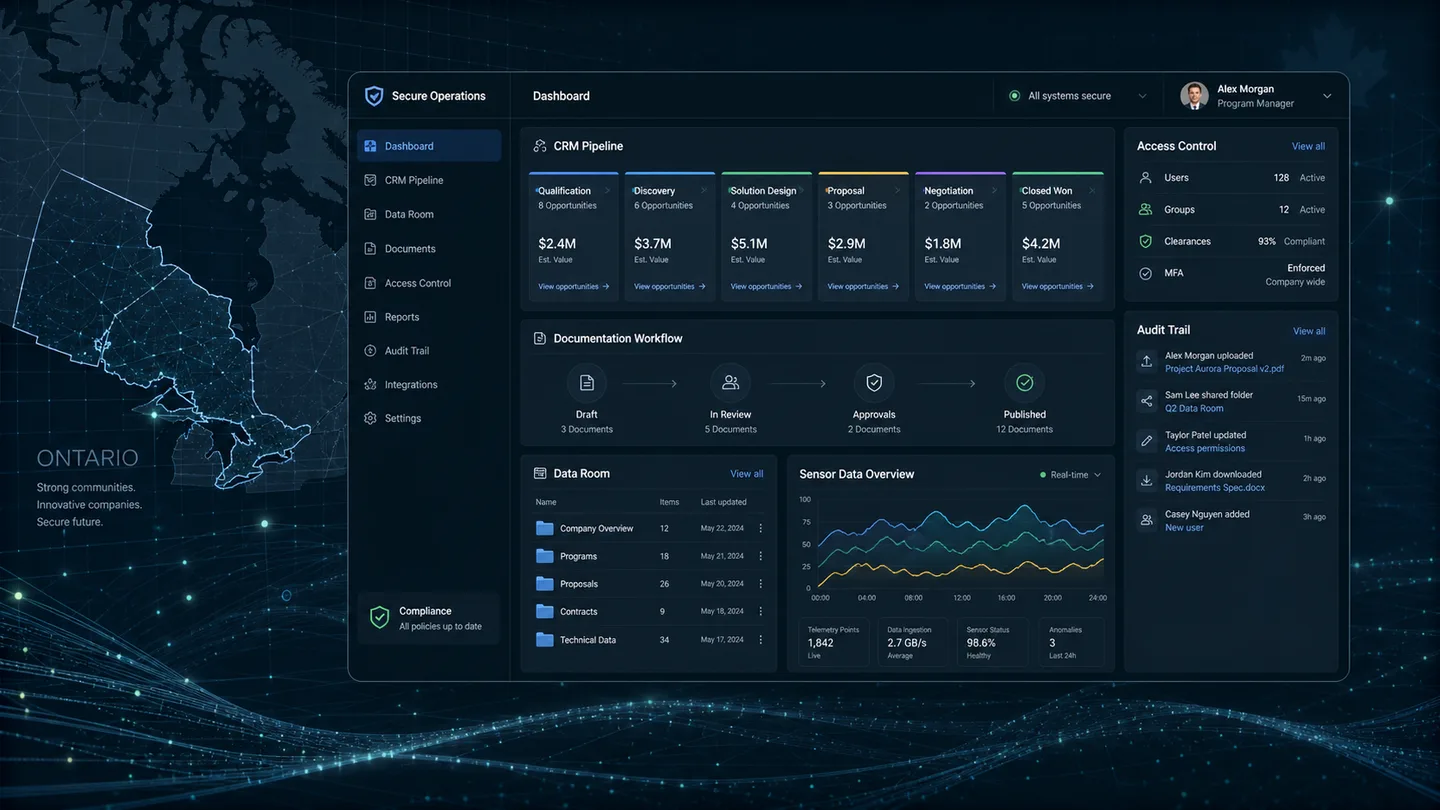
A defence CRM in Canada should do more than list contacts. It should reflect how the company actually moves from discovery to qualification, technical validation, partner alignment, pilot, proposal, procurement, and delivery. Generic sales stages are often too loose for defence and dual-use technology Ontario companies because one opportunity may involve a prime, an end user, a government program, an innovation challenge, and a grant or investment conversation at the same time.
Zap Media often sees the same problem in early-stage defence firms: key opportunity knowledge lives across founder inboxes, spreadsheets, decks, meeting notes, and memory. That can work for a handful of conversations. It breaks when a real procurement or partnership window opens and the team needs to answer quickly with consistent evidence.
A procurement-ready CRM should capture requirement themes, buyer or partner role, security sensitivity, data-sharing limits, demonstration status, technical dependencies, next action, document package status, and decision date. It should not become bureaucratic. It should reduce the number of times leadership asks, "Where are we with this?"
Secure documentation is part of the product
Defence technology companies need documentation long before a formal bid. Product descriptions, architecture diagrams, security notes, testing evidence, data sheets, user guides, integration assumptions, export-control questions, privacy notes, and implementation plans are all part of how credibility is judged. If those files are hard to find, out of date, or inconsistently shared, the company looks less ready than the technology may be.
Secure documentation workflows for defence do not require theatrical "classified" design. They require sensible controls: access levels, version history, review ownership, document status, approved external packages, and a clean separation between public collateral and sensitive technical material. AI can help summarize, classify, draft, and retrieve documents, but only when the team defines what data can be used and where human review is mandatory.
That is where AI research and automation should be practical. A defence startup may benefit from AI-assisted proposal summaries, requirements extraction, internal knowledge search, support triage, or document comparison. But the workflow needs governance. No serious team should paste sensitive technical material into uncontrolled tools and call it modernization.
Digital credibility matters before the meeting
Canadian defence startup software also includes the public-facing and partner-facing surfaces around the product. A buyer, prime, investor, or program officer may first encounter the company through its website, data room, product portal, demo environment, or onboarding workflow. Those systems should make the company easier to trust.
For defence technology companies, digital credibility usually means clear product positioning, credible technical language, a defensible use-case page, secure intake, focused documentation, and a path for serious stakeholders to understand the technology without overexposing sensitive details. This is related to our earlier article on why defence startups need software that can keep up with the market: the market is moving faster than many internal systems.
The goal is not to create a heavy enterprise stack too early. It is to remove avoidable friction. If a founder has to manually assemble the same document set for every partner conversation, the company is paying an invisible tax. If an opportunity is missed because evidence was buried in someone's inbox, the software stack is now a growth constraint.
A practical readiness checklist
Before a major defence opportunity arrives, an Ontario team should be able to answer yes to these questions:
- Does the CRM show opportunity stage, owner, next action, partner role, and document status?
- Is there a controlled data room for approved external material?
- Are product claims backed by current technical notes, demo evidence, or testing records?
- Can leadership separate public marketing content from sensitive technical material?
- Are AI tools governed by clear rules about data use, review, and auditability?
- Does the website explain the product, audience, and use case without resorting to hype?
- Can the team produce a current capability brief, pilot plan, and implementation overview quickly?
These are not legal, export, or procurement advice questions. They are operating questions. Zap Media helps teams improve the software and workflows around those operating questions so the business looks as disciplined as the technology.
Build readiness while the pipeline is still quiet
The worst time to design secure documentation workflows is the week a serious partner asks for them. The worst time to clean a CRM is after six months of opportunity history has gone stale. The worst time to define AI usage rules is after sensitive material has already moved through unmanaged tools.
Ontario defence tech companies can use quieter periods to build the systems that make later opportunities easier to handle. That may mean a CRM cleanup, a secure document workflow, a data room, an internal product evidence library, an AI-assisted research workflow, a better website, or a lightweight portal for pilots and partners.