
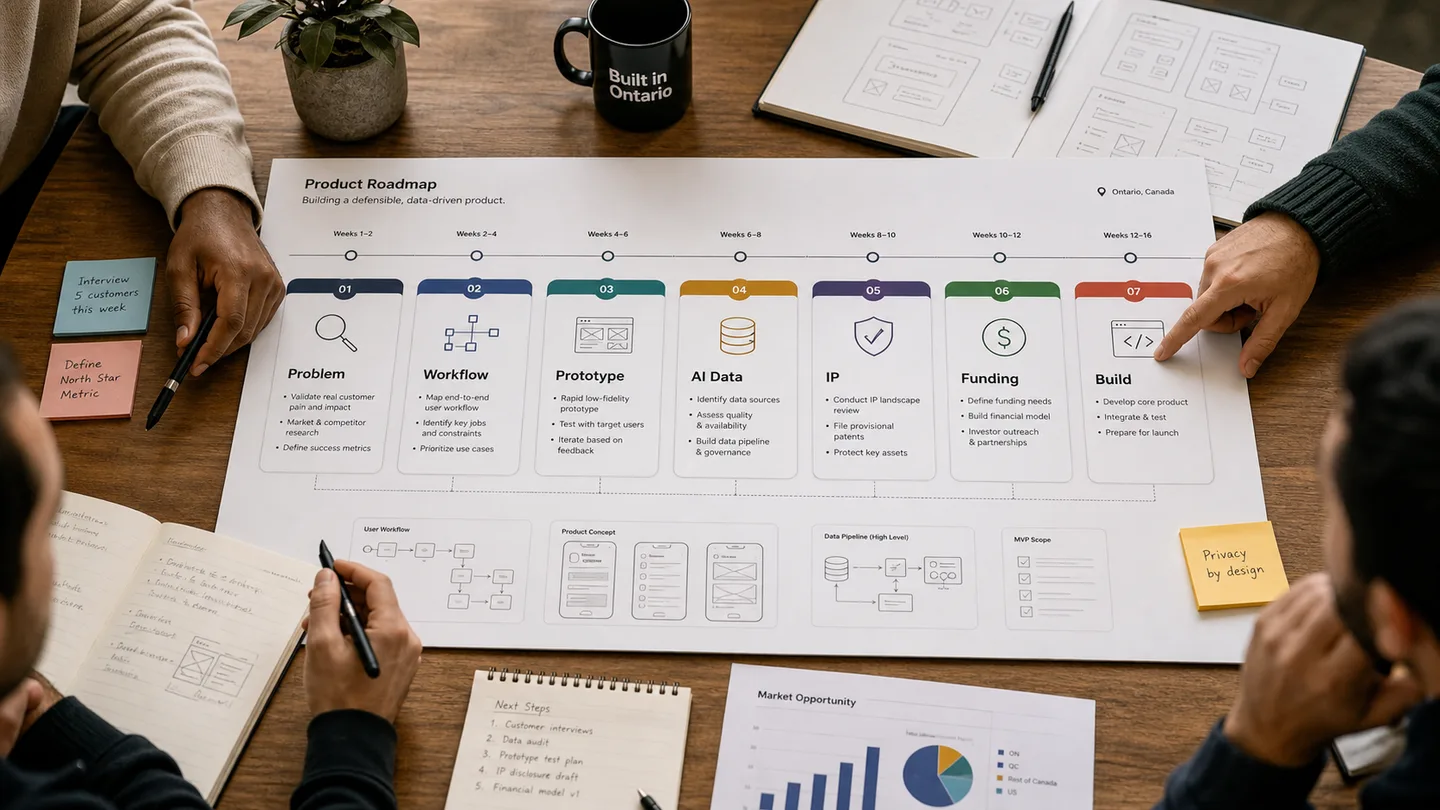
A startup MVP is not automatically grant-ready because it uses AI. It becomes easier to explain, fund, build, and defend when the team can show the problem, workflow, prototype path, data assumptions, IP thinking, and implementation plan before development begins.
Founders searching for grant ready MVP Ontario, AI MVP development Ontario, or startup MVP funding Canada are often trying to solve two problems at once. They need a product that can reach customers, and they need a technical story that is clear enough for investors, advisors, accelerators, program administrators, or tax-credit specialists to understand. Those are related, but they are not the same thing.
At a glance
A grant-ready MVP is scoped with evidence. It identifies the customer problem, the workflow being improved, the prototype boundary, the AI data requirements, the IP questions, the funding assumptions, and the first build. It does not promise that funding will arrive. It simply gives the startup a cleaner technical direction and better documentation for the conversations that follow.
Zap Media supports startups with software, AI adoption, workflow mapping, product scoping, and implementation. We are not a legal, tax, or grant advisor. We help founders turn a fuzzy product idea into a roadmap that builders can execute and stakeholders can evaluate.
Start with the workflow behind the product
Many AI startup ideas begin as a feature: a chatbot, scoring engine, document assistant, recommender, forecast, or automation layer. The better starting point is the workflow. Who has the problem? What are they doing today? Where does time, risk, confusion, or cost appear? Which part of the workflow should the MVP actually change?
This matters because funding and advisory conversations usually punish vague scope. "We are building AI for operations" is broad. "We are helping property managers classify maintenance requests, extract vendor context, and route urgent jobs with human approval" is easier to evaluate. The second version contains a user, a workflow, data, risk, and a first product boundary.
Zap Media's product studio work often starts by reducing the idea, not expanding it. The MVP should be small enough to build and learn from, but specific enough to prove that the startup understands the operating problem. That is also where AI becomes more credible. An AI feature with no workflow is a demo. An AI feature inside a real decision path can become a product.
Know which evidence belongs in the roadmap
Ontario startup software roadmaps should separate four types of evidence. Customer evidence explains the problem and buyer. Workflow evidence shows where the product intervenes. Technical evidence explains data, model, integration, security, and architecture assumptions. Commercial evidence shows the first route to adoption, pricing, or pilots.
Those categories are useful even when no grant is involved. They become especially useful when a founder is preparing for programs, accelerators, non-dilutive funding, or tax-credit conversations. The Canada Revenue Agency's SR&ED tax incentives page describes SR&ED as intended to encourage research and development in Canada. The CRA's eligibility page emphasizes technological advancement and systematic investigation or search. That does not mean every software build qualifies. It means founders should document uncertainty, experiments, decisions, and learning instead of trying to reconstruct them months later.
IP also belongs early. ISED describes ElevateIP as helping Canadian innovators and SMEs turn IP into a business advantage, while regional delivery partners such as Invest Ottawa describe support for IP knowledge, IP strategy, and IP assets. Founders do not need to become lawyers. They do need to know what they are creating, what data or models they depend on, and what should be discussed with qualified IP counsel.
Scope AI before you build AI
AI MVP development in Ontario should begin with data questions. What data exists today? Who owns it? Is it structured? Can it be used for this purpose? What outputs need human review? What happens when the model is wrong? Is the product using retrieval, classification, prediction, generation, workflow automation, or a combination?
Without those answers, an AI MVP can look impressive in a demo and fail in production. A founder may build a polished interface before learning that the data is unavailable, privacy constraints are tighter than expected, the model cannot be evaluated, or the user does not trust automated recommendations. The MVP should test the riskiest assumption early.
Zap Media helps founders design practical AI product roadmaps: prototype scope, workflow boundaries, data requirements, AI usage policy, evaluation criteria, user feedback loops, and phased implementation. The point is not to make the first version look bigger. The point is to make it buildable and honest.
A practical grant-ready MVP checklist
Before building, an Ontario AI startup should be able to answer the following:
- What exact workflow does the MVP improve?
- Who is the first user, buyer, or pilot customer?
- What problem evidence supports the product direction?
- Which data sources are required, and what permissions or privacy limits apply?
- Where does AI make a decision, recommendation, summary, or routing action?
- Where is human review mandatory?
- What technical uncertainty should be documented during the build?
- Which IP questions should be raised with qualified advisors?
- What is included in the first release, and what is intentionally excluded?
This checklist will not guarantee startup MVP funding in Canada. It will make the startup easier to evaluate. It also helps the development team avoid building around assumptions that no one has tested.
Build a product, not a funding artifact
The risk in "grant-ready" language is that founders begin optimizing for applications instead of customers. That is backwards. A clear roadmap should serve the product first. Funding, SR&ED documentation, IP strategy, accelerator conversations, and investor diligence should benefit from that clarity, not replace it.
We wrote more broadly about this in why grant and tax credit navigation needs to become easier for SMBs and startups. Founders need better systems around funding research, documentation, eligibility conversations, and technical evidence. But the software still has to solve a real problem.
A strong MVP scope gives a startup a disciplined starting point: customer problem, workflow, prototype, AI data, IP, funding assumptions, and build plan. From there, the team can learn quickly, improve the product, and speak with advisors from a stronger position.